

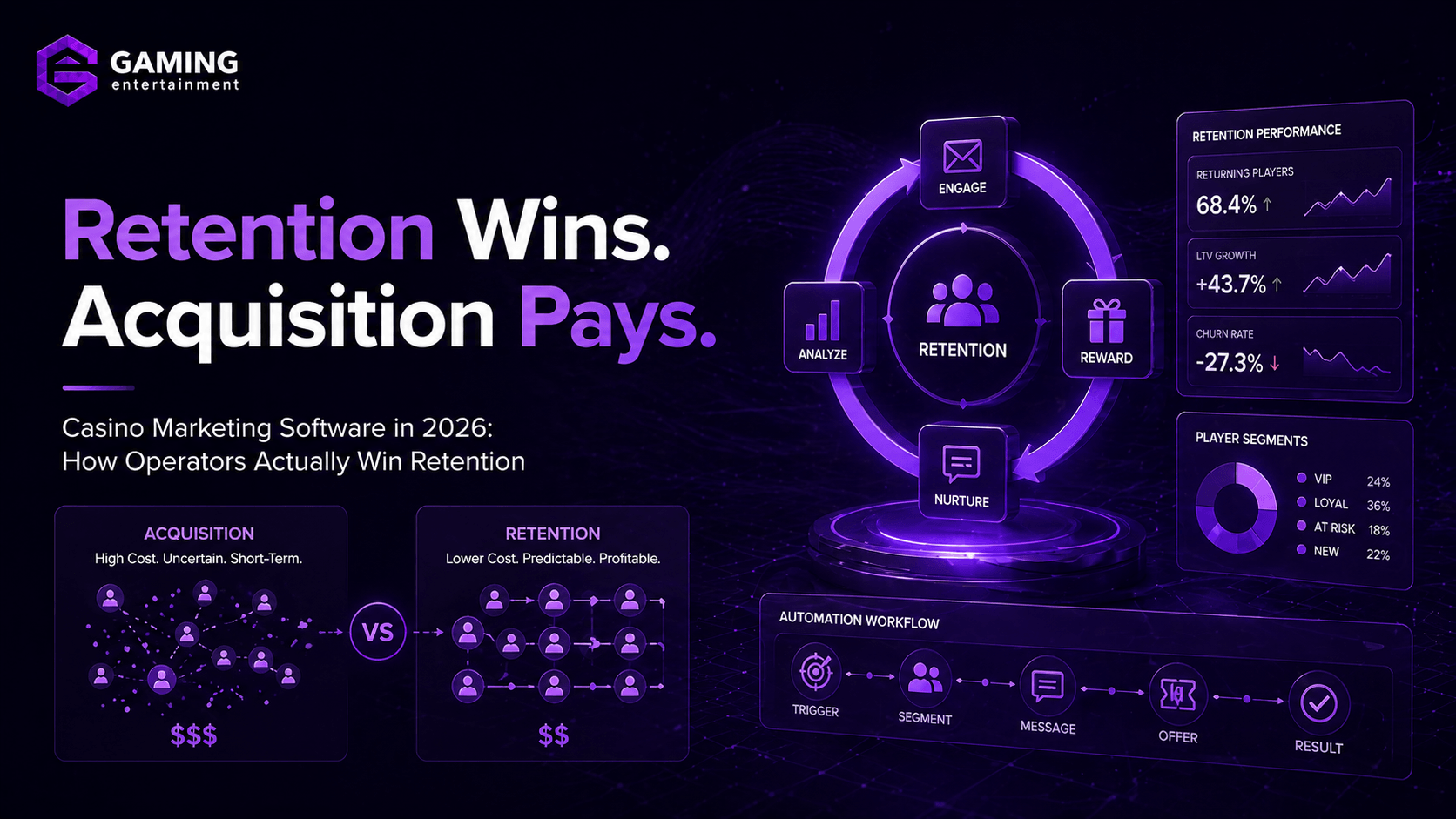
Player acquisition has gotten expensive. Retention is what separates operators who scale from operators who burn capital chasing a churning user base.
The economics are well known. Acquisition costs have steadily climbed across regulated markets, with top SEO keywords for iGaming now bidding above $350 in some jurisdictions. The gap between acquiring a new player and reactivating a lapsed one keeps widening. Operators who got ahead of this shift stopped competing on welcome bonus size and started focusing on personalisation, automation, and how quickly their CRM can respond to behavioural signals. The ones who didn’t are still acquiring, still paying premium CAC, and still watching most of those players leave within the first 30 days.
Fortuna is built for the second group of operators - the ones who realise that retention, lifetime value, and integrated technology are where margin lives.
Why Most iGaming CRMs Don't Actually Work
Most CRMs in this industry were built for e-commerce and retrofitted for gambling. The result is software that handles email lists competently but handles player retention poorly. The alternative most operators end up with - stitching together five separate vendor tools for CRM, bonus management, affiliate tracking, risk, and analytics - produces a different kind of failure. Data drifts between systems. Rules conflict. A reactivation campaign goes out to a player your fraud engine flagged yesterday because the two systems don't share state. A VIP offer lands with someone who self-excluded last week because the CRM doesn't see the compliance flag. Each tool works in isolation. None of them works together.
This is the operational tax of fragmented marketing technology, and in 2026, it's the difference between operators who retain and operators who don't.
Fortuna consolidates the full stack - CRM, player management, automation engine, bonus campaign builder, multi-level affiliate platform, risk and AML protection, and real-time dashboards — into a single back office where every layer informs the others. No toggling between tools. No manual reconciliation. No integration projects limping into their third year.
What Real-Time Personalisation Actually Looks Like
Personalisation is the most overused word in iGaming marketing and the least practised discipline. Until recently, true personalisation was largely reserved for VIP players because the operational cost of segmenting, building, and delivering tailored journeys to everyone else was too high. AI and behavioural automation have collapsed that cost, and the operators getting ahead are extending VIP-style treatment through the full player base.
What this looks like operationally is the right bonus, sent to the right player, at the right moment. A player who deposits weekly on Friday evening shouldn't get a generic Monday-morning push. A casual slots player shouldn't be receiving sportsbook reload offers. A high-roller showing early disengagement signals - drop in session frequency, slower deposit cadence, shorter playtime - should trigger a reactivation flow before they've fully churned, not after. These aren't aspirational scenarios. They're the baseline standard among operators winning on retention right now.
The most consequential shift is from reactive to predictive. Top operators now treat behavioural signals as early indicators of churn and trigger personalised interventions before the player goes silent. By the time someone has stopped logging in, you've largely lost them. The retention work has to happen earlier in the curve.
Doing this well requires a CRM that tracks real-time betting activity, segments players by behaviour and value rather than just demographics, and triggers actions - a bonus, a message, a document request, or an account freeze — within seconds of the qualifying event. Generic broadcast marketing trains players to ignore your channels. Real-time personalisation earns their attention.
What an Integrated Platform Actually Delivers
Most platforms describe themselves as "all-in-one", but don't operate that way. The integration claim is what makes Fortuna structurally different.
Real-time segmentation and event-driven automation lift retention while a campaign is still running, not after the post-mortem. A unified player wallet and profile view across brands, products, and currencies eliminates the visibility gaps where bonus abuse and multi-accounting hide. Omnichannel communication across email, SMS, push, and on-site banners runs from a single rule set with consistent consent management. The bonus engine launches rule-based campaigns - free spins, cashback, hybrid offers - in minutes, with built-in eligibility logic that respects KYC status, responsible gambling settings, and risk scores. Compliance tooling for responsible gambling, exclusions, and jurisdictional restrictions runs natively rather than as a bolt-on. The integrated risk and anti-fraud layer protects revenue while feeding behavioural signals back into segmentation, so suspicious activity reshapes campaign targeting in real time.
The automation engine ties it all together with conditional logic: when a defined trigger fires, under specific conditions, a specific action follows. Whether that's freezing a bonus for a player who just crossed an abuse threshold, sending a reactivation offer to a VIP whose session frequency has dropped, requesting source-of-funds documentation when a deposit pattern shifts, or restricting play for a self-exclusion request, the rules execute consistently, around the clock, without anyone in the operations team needing to be online.
For affiliate-led acquisition, multi-level architecture lets you scale channels without losing visibility into sub-affiliate performance, attribution accuracy, or fraud signals at any tier of the network. The dashboard layer surfaces every KPI, campaign performance metric, and player trend in real time, so strategic decisions are made on current data rather than last week's.
The Practices That Separate Winners From CAC Bills
A few habits separate operators with healthy retention from operators with healthy customer acquisition cost bills.
Split-test continuously across landing pages, bonus structures, subject lines, and creative. The instinct to "set and forget" a campaign is one of the most expensive habits in iGaming marketing. Segment deeply - beyond casual versus VIP. RFM segmentation (recency, frequency, monetary value), combined with game preference and channel responsiveness, yields cohorts that behave differently and respond to different offers. Automate routine campaign management so your marketing team’s time goes into strategy and creative, not manual reward distribution. Build localised offers that account for geography, payment preference, and culturally relevant promotion - generic global campaigns convert at a fraction of the rate of localised ones.
Track the right KPIs weekly, not monthly. Customer acquisition cost, lifetime value, ARPU, retention rate by cohort, churn rate, GGR per active player, and payment success rate are the metrics that show whether your marketing is actually working. Operators who track these weekly catch problems while they’re still fixable.
Where Operators Still Leak Revenue
Despite advances in technology, the same mistakes still show up time and again. Sending the same bonus to every player wastes promotional budget and trains your audience to expect generic offers. Manually distributing rewards is slow, error-prone, and doesn’t scale. Operating without churn prediction means you’re always reacting to lost players instead of retaining engaged ones. Slow response to risky behaviour exposes you to fraud losses and responsible gambling concerns that regulators take seriously. And unmonitored affiliate fraud quietly drains your acquisition budget while inflating your headline numbers.
Each of these mistakes leads directly to lost revenue. The cumulative effect is often the difference between an operation that compounds and one that just treads water. They also share a common cause - they’re symptoms of fragmented tooling, where the system that should catch the problem can’t see what the system that caused it knows.
Turn Player Data Into Player Loyalty
The operators winning in 2026 aren’t the ones with the loudest marketing or the biggest welcome bonuses. They’re the ones whose CRM, bonus engine, affiliate tracking, and risk controls all share the same data layer and act on it in real time.
With Fortuna, that’s the default architecture. Real-time segmentation, automated retention flows, integrated analytics, and CRM, bonus, affiliate, and risk tools all run on a single stack - not five separate vendor relationships you’re trying to make work together.
Fortuna takes the data your platform already generates and turns it into retention, the campaigns you're already running and turns them into measurable lift, and the players you've already acquired and turns them into the long-term LTV that actually justifies the CAC.
If you’re building or scaling an iGaming operation and your marketing stack is fragmented across multiple tools, it’s costing you more than you can see in the dashboard. Contact us at [email protected] to book a demo.